Nutella

Nutella is the brand name of a hazelnut-based sweet spread registered by the Italian company Ferrero at the end of 1963. The recipe was developed from an earlier Ferrero's spread released in 1949. Nutella is now marketed in over 75 countries across the globe. It has become a large sensation among the chocolate-loving crowd, with its own World Nutella Day
Gianduja is a type of chocolate containing about 50% almond and hazelnut paste that was developed in PiedmontItaly after excessive taxes on cocoa beans hindered the diffusion of conventional chocolate. Pietro Ferrero owned a patisserie in Alba, in the Langhe district of Piedmont, an area known for the production of hazelnuts. In 1946 he sold an initial batch of 300 kilograms (660 lb) of "Pasta Gianduja". This was a solid block, but in 1949 Pietro developed his first spread, which he first sold in 1951 as "Supercrema".
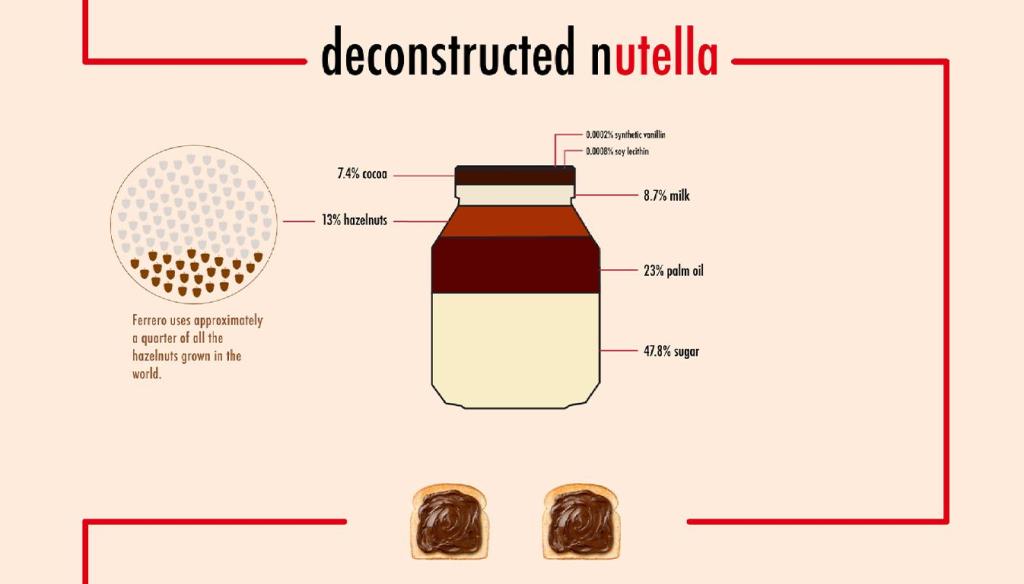
Nutella is a modified form of gianduja. The exact recipe is a secret closely guarded by Ferrero. According to the product label, the main ingredients of Nutella are sugar and modified vegetable oils, followed far behind by hazelnutcocoa and skimmed milk, comprising together at most 28% of the ingredients. The recipe for Nutella varies in different countries. In the case of Italy the formulation uses less sugar than the product sold in France. Nutella is marketed as "hazelnut cream" in many countries; it cannot be labeled as a chocolate cream under Italian law, as it does not meet minimum cocoa concentration criteria.
About half of the calories in Nutella come from fat (11g in a 37g serving, or 99 kcal out of 200 kcal) and about 40% of the calories come from sugar (20g, 80 kcal).
In 1963, Pietro's son Michele Ferrero decided to revamp Supercrema, with the intention of marketing it Europe-wide; its composition was modified, as well as the label image and brand name: the name "Nutella" (based on the word "nut") and its logo were registered towards the end of the same year, and remain unchanged to this day. The first jar of Nutella left the Ferrero factory in Alba on April 201964. The product was an instant success, and remains widely popular. The estimated Italian production of Nutella averages 179,000 tons per year.

Visual of the Day

Tableau Public is a platform where authors can visualize their data and share their work with thousands of like-minded data enthusiasts around the world. Every weekday, the Tableau Public team selects one data visualization to be featured as Viz of the Day (VOTD). How are these vizzes selected? How can VOTD benefit you? And how can you get involved? I decided to talk to the Tableau Public team to round out my knowledge about the Viz of the Day program.

follow the link to get started

MakeoverMonday – Forum Tableau

We’re hurtling towards the end of the year at quite a rate now. For week 49 I found some data via the always excellent Pew Research resource. It contained a chart which in itself is a favourable re-viz of the original, but it was when I navigated to the source data that I found the […]

#MakeoverMonday 2020 Week 49 — learningtableaublog

Python For Beginners

Welcome! Are you completely new to programming? If not then we presume you will be looking for information about why and how to get started with Python. Fortunately an experienced programmer in any programming language (whatever it may be) can pick up Python very quickly. It’s also easy for beginners to use and learn, so jump in!

Installing

Installing Python is generally easy, and nowadays many Linux and UNIX distributions include a recent Python. Even some Windows computers (notably those from HP) now come with Python already installed. If you do need to install Python and aren’t confident about the task you can find a few notes on the BeginnersGuide/Download wiki page, but installation is unremarkable on most platforms.

Learning

Before getting started, you may want to find out which IDEs and text editors are tailored to make Python editing easy, browse the list of introductory books, or look at code samples that you might find helpful. There is a list of tutorials suitable for experienced programmers on the BeginnersGuide/Tutorials page. There is also a list of resources in other languages which might be useful if English is not your first language. The online documentation is your first port of call for definitive information. There is a fairly brief tutorial that gives you basic information about the language and gets you started. You can follow this by looking at the library reference for a full description of Python’s many libraries and the language reference for a complete (though somewhat dry) explanation of Python’s syntax. If you are looking for common Python recipes and patterns, you can browse the ActiveState Python Cookbook

Looking for Something Specific?

If you want to know whether a particular application, or a library with particular functionality, is available in Python there are a number of possible sources of information. The Python web site provides a Python Package Index (also known as the Cheese Shop, a reference to the Monty Python script of that name). There is also a search page for a number of sources of Python-related information. Failing that, just Google for a phrase including the word ”python” and you may well get the result you need. If all else fails, ask on the python newsgroup and there’s a good chance someone will put you on the right track.

Frequently Asked Questions

If you have a question, it’s a good idea to try the FAQ, which answers the most commonly asked questions about Python.

Looking to Help?

If you want to help to develop Python, take a look at the developer area for further information. Please note that you don’t have to be an expert programmer to help. The documentation is just as important as the compiler, and still needs plenty of work!

Python Beginners

How to visualise decision tree in Graphviz

Graphviz is one of the visualization libray. The gratness of graphviz is that it’s a open source visualiztion library. Graphiz widely used in networking applicaiton where to visulaze the connection beteen the swiths hub and differnt networks. When it’s comes to machine leanring used for decision tree and newral networks.

Now let’s look at how to visualise the decision tree with graphviz.